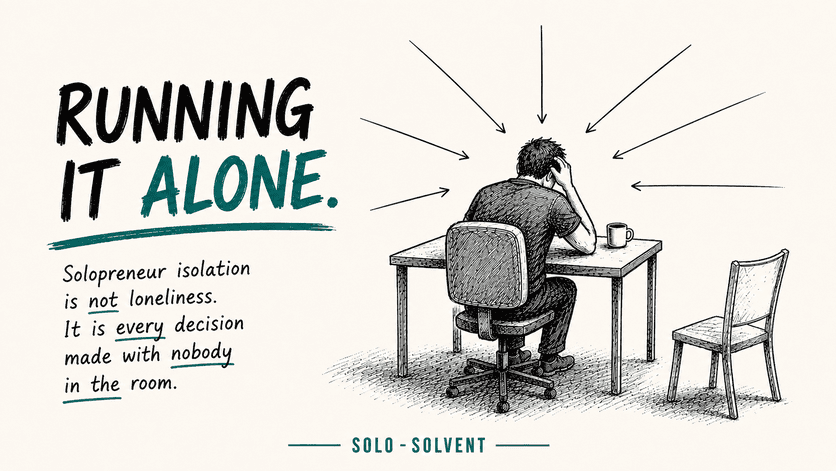
Solopreneur isolation is not just about being lonely. It is what happens when every decision in your business, big or small, gets made by one person with no one else in the room to check it. That includes pricing, client selection and growth decisions. In practice, this is one of the more overlooked reasons solo businesses stall, not because of a lack of demand, but because too many decisions went untested before they were acted on.
If you run a service business alone and feel like you are carrying the full weight of every choice, this is not a sign that something is wrong with you. It is a structural gap that most solo businesses share, and it has a practical fix.
Why Isolation Is a Real Business Problem, Not Just a Feeling
Most advice aimed at solopreneurs treats isolation as an emotional side effect of working alone, something to manage with better routines or more social contact. That misses what is actually happening.
When you work for someone else, your decisions get filtered before they cause damage. A colleague raises an eyebrow at a bad idea. A manager asks the question you had not thought of. Even a mediocre workplace has some version of this filter built in.
Running a business alone removes that filter completely. Every decision, from which client to take on to how to price a new service, gets made by one person, often while anxious about money and short on time to think it through properly.
This connects directly to how isolation connects to the other five pressure points in the wider solopreneur pressure loop. Money stress leads to rushed decisions. Rushed decisions lead to the wrong clients or under-priced work. That leads to more overwork and even less time to think clearly next time. Isolation is not a side pillar in this cycle. It is often where the cycle starts.
Prefer to Watch?
Here’s a short video breakdown of the main idea and one practical step you can apply today.
What Solopreneur Isolation Actually Looks Like
Solopreneur isolation rarely shows up as obvious loneliness. It shows up as small, repeated moments where a decision that matters gets made without anyone to sense-check it.
In practice, this tends to look like:
- Taking on a client you had doubts about, because there was no one to talk you out of it
- Setting a price from fear rather than from a clear framework, because no one questioned the number
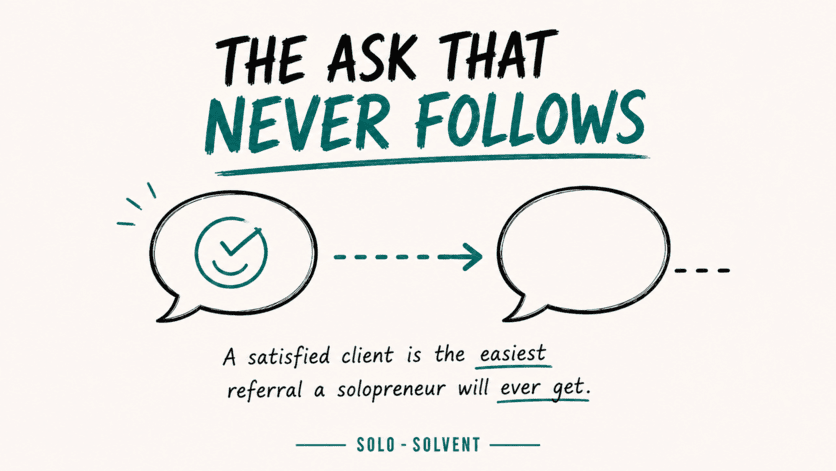
- Avoiding a growth activity that felt exposing, such as asking existing clients for referrals, because the doubt in your own head went unchallenged
- Making a big decision, a hire, a rate change, a client exit, in one sitting, alone, then living with it
None of these moments look like loneliness in the traditional sense. They look like ordinary business decisions. The isolation is in how they get made, not in how they feel at the time.
The Difference Between Isolation and Being Alone
Working alone is a fact of solo business. Isolation is what happens when that fact goes unaddressed. A solopreneur can have a full calendar, a supportive partner and an active social life, and still be isolated in exactly the way that matters here: nobody checking their business decisions before they are made.
This is worth separating clearly, because it changes what the fix looks like. More social contact does not solve decision isolation. A structural stand-in for a second opinion does.
Signs You Are Experiencing Solopreneur Isolation
Solopreneur isolation is easy to miss because it rarely announces itself. It tends to show up as a handful of recurring patterns rather than one obvious moment:
- You make significant business decisions in one sitting, alone, and only think to question them afterwards
- You avoid asking existing clients for referrals or feedback, because it feels exposing rather than routine
- You notice a pricing decision or client boundary you have been putting off for months, with no clear reason why
- You feel confident explaining your work to clients but uncertain the moment a decision affects your own business rather than theirs
- You have no one you would naturally message before saying yes to something that matters
If two or more of these feel familiar, isolation is likely already shaping decisions in your business, whether or not it feels like a problem day to day.
Why This Happens to Almost Every Solo Business Owner
Isolation in a solo business is not caused by a lack of effort or a lack of confidence. It is a structural feature of the business model itself.
There is no natural second voice. Employees have colleagues. Founders with co-founders have a sparring partner. Solopreneurs, by definition, do not have either, so every decision defaults to a single, often exhausted, point of view.
Financial pressure compounds it. When margins are tight, decisions get made faster and under more strain. A rushed decision made under financial anxiety is far more likely to go unchecked, because there is no time built in to pause and ask anyone else. Talker Research’s 2025 study on financial stress found that 76 percent of people dealing with financial strain feel isolated in it. Solopreneurs sit at exactly that intersection: financial pressure with no one else carrying it alongside them, day to day.
Avoidance hides in plain sight. Many solopreneurs avoid asking for outside input because it feels like admitting uncertainty. In practice, this often shows up around growth activities specifically, referral requests, networking, and why solopreneurs underprice in the first place, precisely the decisions that would benefit most from a second opinion. In my own agency’s early years, referrals sat almost entirely untouched for exactly this reason: asking felt riskier than simply doing without.
The solo tax adds up quietly. Every function of the business sits with one person: sales, delivery, admin, strategy. The solo tax is the cumulative cost of doing all of it without anyone to share the mental load, and isolation is where that cost is paid most directly.
What Solopreneur Isolation Actually Costs
The real cost of isolation is not the discomfort of working alone. It is that every gut decision goes untested until it has already cost something.
A client who was never a good fit gets taken on because there was no one to flag the mismatch early, and that mismatch often feeds straight into the feast and famine cycle. A pricing decision gets made reactively because there was no one to challenge the fear behind it. A referral request never happens because the doubt behind avoiding it never got questioned out loud, which is exactly how the pipeline dries up between projects without anyone noticing until it already has.
Individually, these look like small missed opportunities or minor misjudgements. Added together over months or years, they represent a significant and largely invisible drag on a solo business, one that has nothing to do with skill or effort and everything to do with the absence of a second voice.
How Isolation Feeds the Other Five Pressure Points
Isolation rarely stays contained to itself. Because every other pressure point in a solo business ultimately gets resolved by one person’s unchecked judgement, isolation tends to show up as the quiet cause behind problems that look, on the surface, unrelated.
Feast and famine. A client taken on without a second opinion is more likely to be the wrong fit, which shortens the relationship and reopens the income gap sooner than expected.
Pipeline. Growth activities that feel exposing, asking for referrals, following up on quiet leads, are the ones solopreneurs are most likely to avoid without anyone to challenge the avoidance. The pipeline dries up quietly, not through neglect but through untested doubt.
Underpricing. A pricing decision made alone, under financial pressure, tends to default to the safest-feeling number rather than the most accurate one. A second opinion rarely agrees with fear.
Visibility. Decisions about how and where to show up publicly are some of the most exposing a solopreneur makes. Made alone, they are more likely to be postponed indefinitely than tested and refined.
Client boundaries. The decision to push back on scope creep or end a difficult client relationship is a decision like any other. Without a second voice, it is far easier to keep absorbing the cost than to act on it.
In each case, the surface problem, income, pipeline, pricing, visibility or boundaries, is not really the root cause. The root cause is that the decision behind it was made by one person with nobody else in the room.
The Second Opinion Rule: A Practical Framework
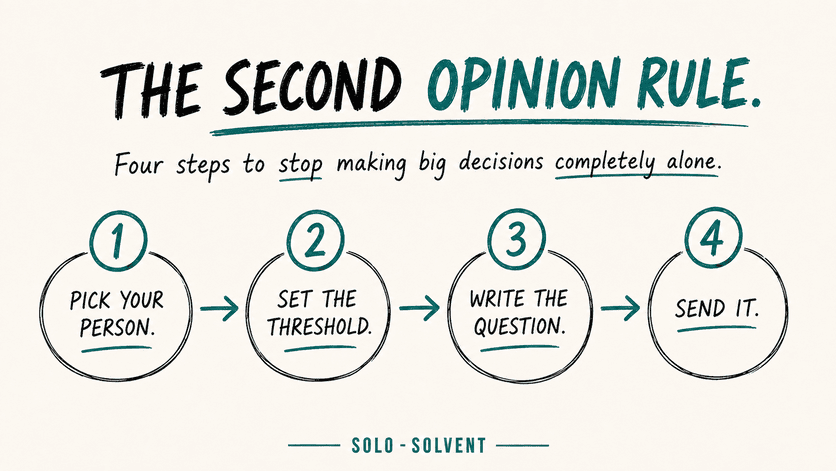
You cannot hire a co-founder to fix this overnight. You can build a structural stand-in for one, and it takes about ten minutes to set up.
Step one: pick one person. This should be a peer, ideally another solo business owner who understands the pressure of a yes-or-no moment because they live it too. Not a partner, not a parent, not a friend who will simply agree with you.
Step two: decide what counts. Set a clear threshold for which decisions go through the rule. A sensible starting point is any decision that would hurt the business if it went wrong for a month or more: a new client, a new hire, a significant spend, a pricing change, or dropping a client.
Step three: write the question down before you decide. Before saying yes to anything that meets the threshold, write down, on paper rather than just in your head, the answer to one question: if this goes wrong in three months, what will I wish I had asked before I said yes?
Step four: send it to your person. Share the decision and your answer with your chosen peer using a simple, consistent message: here is the thing I am about to say yes to, if you were me, what is the one question you would want answered before doing it?
This is not about asking permission. It is about buying back the one thing isolation removes: a second set of eyes on a decision before it becomes a mistake that costs months to unwind.
The rule works because it changes when the check happens. Most solopreneurs only get a second opinion after a decision has gone wrong, from a client who left, a rate that felt too low in hindsight, or a lead that went cold. Moving that check to before the decision is what actually breaks the pattern, rather than simply reflecting on it afterwards.
Common Mistakes to Avoid
- Treating isolation as a confidence problem.
Isolation is not solved by feeling more confident. It is solved by building a structure that catches decisions before confidence, or the lack of it, gets to make the call alone.
- Choosing the wrong person for a second opinion.
A supportive partner or a well-meaning friend who does not run a business will usually reassure you rather than sense-check you. That instinct comes from care, not from a lack of judgement on their part, but it is the wrong tool for this specific job. The rule works best with a peer who understands the specific pressure of solo decision-making, because they are less likely to soften the question you actually need asked.
- Only applying the rule to big, obvious decisions.
Some of the most costly unchecked decisions are quiet ones, avoiding a referral ask, softening a difficult client conversation, delaying a rate increase. These rarely feel urgent enough to flag, which is exactly why they tend to go unchecked for the longest. They deserve the same second opinion as a big hire, not less scrutiny because they feel smaller in the moment.
- Waiting until something has already gone wrong.
The value of a second opinion is in preventing the mistake, not diagnosing it afterwards. The Second Opinion Rule only works if it happens before the yes, not after.
5. Assuming more social contact solves it.
Isolation here is specifically about business decisions going untested, not about general loneliness. A busy social calendar does not fix a business decision made without a second voice.
Frequently Asked Questions
What is solopreneur isolation?
Solopreneur isolation is the structural absence of a second person to check business decisions against. It is different from general loneliness and specifically affects the quality of decisions made alone under pressure.
Is solopreneur isolation the same as loneliness?
Not exactly. A solopreneur can have an active social life and still be isolated in the way that matters most for their business: having no one to sense-check pricing, client and growth decisions before they are made.
How does isolation affect business decisions?
Working alone removes the natural filter that colleagues or managers provide in most workplaces. Without that filter, decisions tend to get made faster, more emotionally and without being tested before they are acted on.
What is decision fatigue for solopreneurs?
Decision fatigue is the cumulative strain of making every business decision, large and small, without anyone to share the load. It compounds over time and often shows up as avoidance of the decisions that matter most, such as pricing or growth activities.
How can a solopreneur reduce isolation without hiring staff?
The most practical fix is building a structural stand-in for a second opinion, such as the Second Opinion Rule outlined above, rather than trying to solve isolation through social contact or hiring.
Is the solo tax the same as isolation?
The solo tax refers to the overall cost of running every function of a business alone. Isolation is one part of that cost, specifically the cost of making decisions without anyone to validate or challenge your thinking.
Read Next
- The Solopreneur Pressure Loop: Why Money Stress, Client Pressure and Isolation All Feed Each Other. For readers who want to see how isolation connects to the other five pressure points before diagnosing which one to address first.
- Feast and Famine Is Not Bad Luck. It Is a Design Problem. For readers whose isolated decisions have shown up most in inconsistent income.
- Why Solopreneurs Underprice (And Why It Is Not a Confidence Problem). For readers whose unchecked decisions have shown up most in reactive pricing.
Take the Pressure Loop Audit
If isolation is the pillar hitting hardest right now, the Pressure Loop Audit will show you exactly where the loop is tightest for your business, in three to four minutes, for free. Take the Pressure Loop Audit