Running a service-based business alone means you are both the delivery person and the rainmaker. There is no one else to find the next client while you finish the current one, and no one else covering the gap when a slow month arrives.
A solopreneur income buffer is a cash reserve built from a percentage of every payment you receive, sized against your personal monthly living costs rather than your business expenses, so a slow month becomes manageable instead of a crisis. Most solopreneurs build the wrong kind of buffer, or none at all, because the standard advice does not account for irregular income, or for running every part of the business by yourself.
This guide covers how to calculate the right number, how to build it without needing a strong month first, and the system that keeps it working once it exists.
Why the Standard Financial Buffer Advice Does Not Work for Solopreneurs
Most financial guidance says to save three to six months of expenses. That advice is built for people with a salary. It assumes a predictable monthly income you are protecting, not creating.
When you run a service-based business alone, income does not arrive in equal instalments. A strong month can be followed by two quiet ones. Many solopreneurs describe checking their bank balance with genuine dread, not because the number is objectively bad, but because there is nothing behind it to answer the question of what happens next.
This connects directly to what we call the six pressure points every solopreneur carries, the solopreneur pressure loop. Money stress feeds client anxiety. Client anxiety feeds overwork or reactive discounting. That underpricing feeds more money stress. An income buffer is one of the clearest ways to break that loop at the point it usually starts.
Prefer to Watch?
Here’s a short video breakdown of the main idea and one practical step you can apply today.
The Real Reason a Slow Month Feels Like a Crisis
This is not a confidence problem, and it is not purely a pipeline problem either, even though it often gets treated as both. It is a buffer problem. Without one, a quiet week triggers the same stress response as a genuine financial threat, and that stress response drives the decisions that follow.
That is where the damage compounds. A solopreneur without a buffer is more likely to accept a client they should decline, drop a rate to close a deal faster, chase an inconsistent pipeline harder instead of addressing the real gap, or say yes to scope creep because losing the retainer feels unaffordable. None of these are pricing or client management failures on their own. They are downstream effects of having no floor.
The Problem with Saving a Business Emergency Fund
Business expense savings target the wrong number for most solopreneurs. Software subscriptions, a laptop, occasional contractor costs, these are usually small and manageable even in a slow month.
What actually creates fear is the personal cost of a quiet month: rent or mortgage, food, bills, the basics of living. A buffer built around business overheads does not address that fear, because it was never solving for the right problem.
There is also no one else in a one-person service business to absorb the gap while you work it out. An employee going through a slow patch still gets paid. A solopreneur going through the same slow patch is both the person who needs the money and the only person who can go and find more of it, which is exactly why the number has to be personal, not operational.
How to Calculate Your Personal Floor Number
Your personal floor number is the minimum amount you need each month to cover your own living costs, stripped back to essentials. Not your usual spending. Not your business running costs. Just what keeps the lights on and the fridge stocked if a month brought in nothing at all.
To calculate it:
- List your fixed personal costs: rent or mortgage, utilities, food, transport, insurance, minimum debt repayments.
- Add a modest allowance for essentials you cannot realistically cut, such as childcare or medication.
- Exclude discretionary spending and business costs entirely. This number is about survival, not comfort.
- Total the figure. This is your personal floor number, and it is the number your buffer is actually protecting.
Most solopreneurs are surprised by how much lower this number is than their usual monthly income. That gap is useful information. It shows how much room exists to build a buffer without needing an exceptional month first.
The Income Buffer Framework
Once you know your personal floor number, the system itself is simple. The habit matters more than the size of any single transfer.
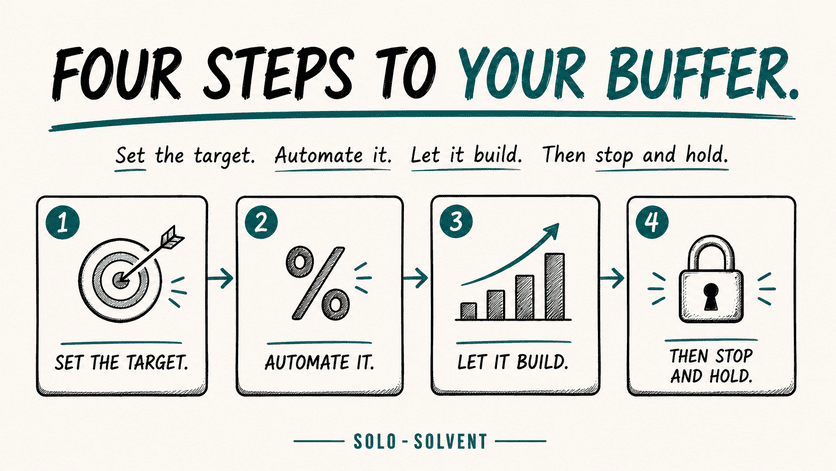
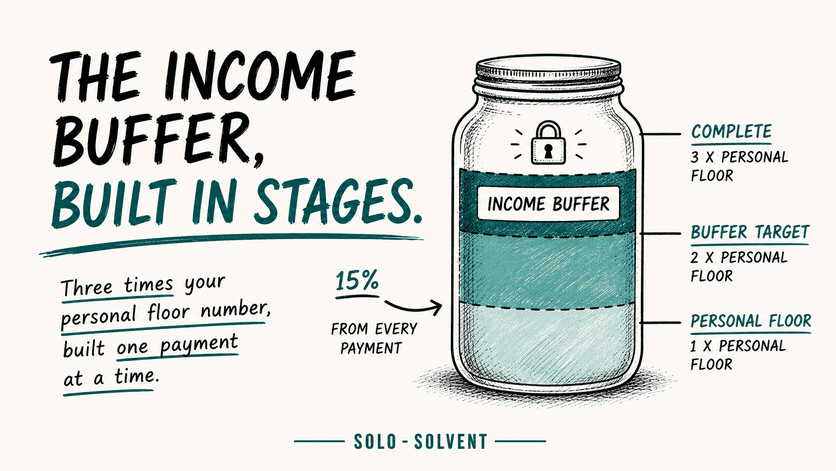
Step 1: Set the target. Multiply your personal floor number by three. This is your buffer target, not three months of guessing, three months of knowing exactly what it covers.
Step 2: Automate the percentage. Every time a client payment lands, move 15 percent of it into a separate account immediately, the same day. Do not wait to decide whether you can afford it that week. The decision is made in advance, not in the moment.
Step 3: Let it build without touching it. Keep transferring until the account reaches your target. Resist the temptation to dip into it for anything other than a genuine income shortfall.
Step 4: Stop and hold once you hit the target. Once the buffer reaches three times your personal floor number, stop adding to it as a default habit. It exists to be used, not to keep growing indefinitely.
The value of this system is not the maths. It is what changes once the habit is in place. A slow month stops being treated as a crisis and starts being treated as an ordinary part of running a service-based business.
Common Mistakes to Avoid
- Sizing the buffer to business costs instead of personal costs.
This is the single most common error. A buffer built around software subscriptions and business overheads does not address the fear a slow month actually creates.
- Waiting for a strong month to start.
The 15 percent rule works because it applies to every payment, not just the big ones. Starting small and consistent beats waiting for the “right” month that may not come on schedule.
- Treating the buffer as optional savings.
Once it exists, it is easy to dip into for a laptop upgrade or a quiet-month treat. The buffer only works if it is protected for its actual purpose.
- Setting the target too high to feel achievable.
Three times your personal floor number is a real, reachable target. Six or twelve months of full income can feel so distant that the habit never starts at all.
5. Building the buffer but never adjusting it.
Your personal floor number changes as your life does. Revisit it once or twice a year so the buffer stays accurate.
Frequently Asked Questions
How much should a solopreneur keep in an income buffer?
Three times your personal monthly floor number, the minimum you need to cover essential living costs, is a realistic and achievable target for most service-based solopreneurs.
Is a solopreneur income buffer the same as a business emergency fund?
No. A business emergency fund typically covers business expenses like software and equipment. An income buffer covers your personal living costs, which is what actually drives the fear during a slow month.
How do I start an income buffer if I have no savings yet?
Start with the 15 percent rule on your very next payment, regardless of size. The habit of setting money aside consistently matters more than the starting amount.
What if I need to dip into my buffer?
That is exactly what it is for. Use it when a month genuinely falls short, then rebuild it using the same 15 percent habit once income picks back up.
Does an income buffer fix feast and famine income for good?
It does not remove the income cycle, but it removes the panic that usually accompanies it, which changes the decisions you make during a slow patch, particularly around pricing and client selection.
How is this different from general financial advice about saving three to six months of expenses?
General advice targets a salaried income pattern. A solopreneur income buffer is sized against your personal floor number and built through a percentage taken from every payment, which fits the reality of irregular income rather than a predictable monthly wage.
Read Next
- If underpricing is part of what happens when a slow month hits, why solopreneurs underprice and how to build a pricing floor covers the fear-driven pricing pattern in detail.
- For the wider mechanics of inconsistent income, understanding the feast and famine cycle in a solo business breaks down the structural causes beyond the buffer itself.
- If you want to see how this pressure point connects to the other five, the six pressure points every solopreneur carries maps the full pattern.
What to do next
An income buffer will not fix every pressure point in a solo business, but it is one of the fastest ways to stop a slow month from making every other decision worse. If you want to see where else the pressure loop is pulling on you, take the free Pressure Loop Audit. It takes a few minutes and shows you exactly where to focus next.