
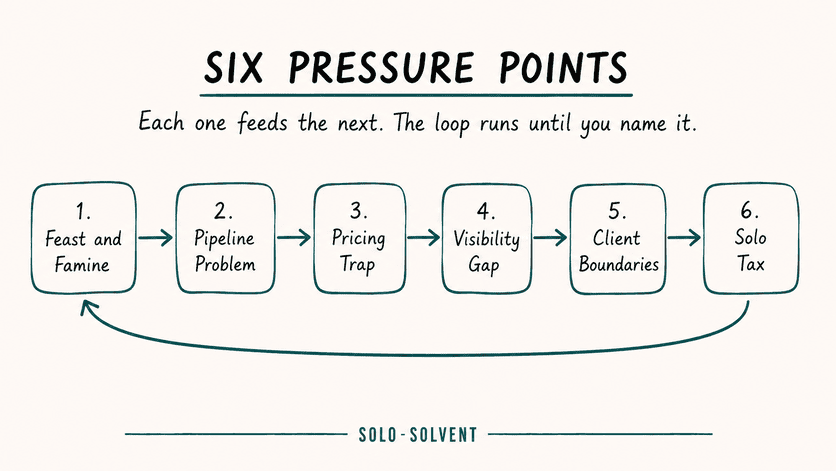
Running a solo service business puts six distinct types of pressure on one person at once. The income is inconsistent. The pipeline empties the moment delivery gets busy. The pricing never feels quite right. New clients only come through word of mouth. Boundaries erode without a system to protect them. And every decision — every single one — lands on the same desk.
These are not random problems. They are connected. They feed each other in a loop that stays invisible until someone names it. Once you can see the loop, you can break it. That is what this framework is for.
Prefer to Watch?
Here is a short video breakdown of the main idea and one practical step you can apply today.
Why Solo Business Pressure is Different
Running a business with a team distributes the pressure. There is someone else to carry the client relationship while you focus on delivery. Someone to keep the pipeline moving when you are head-down on a project. Someone to share the weight of a slow month.
Running a business alone means every one of those functions lands on one person. And when one part goes wrong, it does not stay contained. It bleeds into the rest.
According to the Simply Business Power of One report, 48% of solopreneurs have gone at least one month with no income. 72% of those who considered quitting cited financial stress as the primary reason. 61% said they underestimated how hard it would be to handle every business function alone.
These are not failure statistics. They are the predictable result of a model where one person carries everything with no system in place to manage the pressure.
The six pressure points below are where that pressure most often builds. Most solopreneurs running a service business are carrying at least three of them right now. Some are carrying all six.
The Six Solopreneur Pressure Points
1.Feast and Famine
Inconsistent income is the most commonly reported pressure in solo service businesses. A strong month arrives. The Stripe notifications stack up. Then the pipeline empties and the next month brings almost nothing.
The problem is not just the financial gap. It is what the gap does to decision-making. When income is unpredictable, every client interaction gets filtered through anxiety. You take on more than you should because you are scared to say no. You charge less than you should because losing the client feels worse than losing the margin. You say yes to work that does not fit because turning it down feels like a risk you cannot afford.
Feast and famine is not bad luck. It is the predictable result of a business with no income smoothing system in place.
The control fix: Income buffering, retainer structures, and a financial floor that makes slow months survivable rather than catastrophic.
2.The Pipeline Problem
Most solopreneurs market their business in two situations: when they are starting out, and when they are scared. The moment client work fills the diary, the marketing stops. Which means the post-project dry spell arrives on schedule, every time, because no one kept the pipeline moving during the busy period.
The pipeline problem is structural. When one person is both the delivery resource and the rainmaker, delivery will always win in the short term. The work in front of you is urgent. The pipeline is not. Until it is.
The control fix: A minimum viable pipeline habit that runs in the background during busy periods. Small, consistent, and sustainable rather than reactive and frantic.
3.The Pricing Trap
Pricing in a solo service business is rarely a maths problem. It is a confidence problem. Rates get set reactively: based on what competitors charge, what the last client paid, or what feels safe to say without the client going quiet.
The result is a rate that sits below the actual value being delivered. When a lead hesitates, the instinct is to lower the price rather than hold the line. When a good client pushes back on scope, the instinct is to absorb it rather than address it.
Over time, underpricing creates a structural problem. The rates do not cover the real cost of running the business. The workload stays high to compensate for the margin. And the clients attracted at lower rates tend to be the most demanding about availability.
The control fix: A pricing framework built on value rather than anxiety, with a clear process for rate increases and a script for the scope conversation.
4.The Visibility Gap
Word of mouth is not a visibility strategy. It is hope with a better name.
Most solopreneurs running a service business are entirely invisible outside their existing client base. Inbound enquiries depend on whoever a current or past client happens to mention them to. That is not a pipeline. It is a lottery.
The visibility gap compounds the pipeline problem. Without a system that generates awareness consistently, the pipeline only moves when the solopreneur actively chases it, which they only do when they are scared.
The control fix: A minimum viable visibility system. One channel, one consistent output, positioned to reach the right clients without requiring full-time content performance.
5.Client Boundaries
Scope creep is not a client problem. It is a boundary problem. And boundary problems almost always start at onboarding.
When the terms of an engagement are not clearly set at the start, clients naturally expand into the available space. The brief grows. The response window becomes unlimited. The work that was agreed doubles in practice. And because the relationship is already established, the conversation about what it costs feels harder to have than just absorbing it.
The late-evening message. The request that is nowhere in the brief. The client you keep well past the point where the relationship is working, because losing the income feels unthinkable. These are not personality clashes. They are structural gaps.
The control fix: An onboarding document that sets expectations clearly, a response window that protects working hours, and a script for the scope conversation that does not put the relationship at risk.
6. The Solo Tax
Every decision in a solo business lands on one desk. Every problem is one person’s to carry. The client relationship, the delivery, the invoicing, the marketing, the pipeline, the pricing conversation, the scope creep, the slow month. All of it, all the time, all alone.
This invisible overhead is what some call the solo tax. It does not show up in a time audit. It accumulates quietly as decision fatigue, cognitive load and the specific exhaustion of making every call without anyone to sense-check it against.
Research suggests the way people feel about their financial and workload situation can matter more than the objective facts of it. The solo tax is not about how much is on the desk. It is about carrying all of it without a floor, a co-pilot, or a mechanism that makes any of it smaller.
The control fix: Ruthless prioritisation, simple decision frameworks, and a periodic audit of what is taking cognitive space that does not need to.
How the Pressure Points Connect
These six pressure points do not sit in isolation. They form a loop.
Money stress triggers worse client decisions. Worse client decisions eat capacity. Lost capacity stops the pipeline. An empty pipeline creates the next slow month. A slow month feeds money stress. And throughout all of it, the solo tax compounds every stage because there is no one to carry any part of it.
This is the solopreneur pressure loop. It is self-reinforcing and it is invisible until someone names it.
The reason fixing one pressure point rarely fixes the overall pressure is that the other five are still running. The goal is not to solve all six simultaneously. The goal is to identify which point is tightest right now and apply the right control system to it first. That loosens the loop enough to make the next pressure point approachable.
Control systems break the loop. Not harder work. Not better motivation. Structures that make the pressure smaller and more predictable, one part of the loop at a time.
The Practical Framework: Identifying Your Tightest Pressure Point
Before applying any control system, the first move is diagnosis. The tightest point in the loop is where to start — not the most obvious pressure, but the one that is driving the others.
Use these questions to locate it:
Is it money?
Is the bank balance anxiety the primary thing shaping your decisions right now? Are you saying yes to clients you would otherwise decline? Are you charging less than you know you should because you need the invoice?
If yes, the feast and famine pressure point is the current loop driver. The control fix starts with income smoothing.
Is it pipeline?
Are you in a decent month right now but aware, somewhere at the back of your head, that there is nothing behind it? Did the marketing stop when the work came in?
If yes, the pipeline is the current driver. The control fix is a minimum viable pipeline habit that runs during busy periods, not just between them.
Is it pricing?
Is there a rate you have been almost saying for months and keep pulling back from? Did you discount on the last enquiry before they even pushed back?
If yes, the pricing trap is the current driver. The control fix is a pricing framework that removes the emotional decision from the rate conversation.
Is it a client?
Is there someone in your client base right now whose scope has grown beyond what was agreed? Is there a relationship you are maintaining primarily because you cannot afford to lose the income?
If yes, the client boundary problem is the current driver. The control fix starts at the onboarding stage of the next engagement.
Is it visibility?
Is all of your new work coming from existing clients or their referrals? Are you invisible to the clients you actually want?
If yes, the visibility gap is the current driver. The control fix is one consistent channel rather than scattered attempts across several.
Is it the weight of all of it alone?
Is the hardest part of this week not any one task, but the accumulation of decisions with no one to share them with?
If yes, the solo tax is the current driver. The control fix starts with identifying what is taking cognitive space that does not need to.
The answer to whichever question lands hardest is the first lever. Start there.
Common Mistakes to Avoid
Trying to fix all six pressure points at once.
The loop is circular. Working on all six simultaneously spreads effort thin and produces no traction anywhere. Identify the tightest point. Apply one control system. Let that create breathing room for the next.
Treating money stress as the only problem.
Financial anxiety is usually a symptom rather than a cause. The feast and famine cycle, the underpricing, the pipeline gap — these are the upstream drivers. Fixing the money symptoms without addressing the structural causes means the slow month arrives again on schedule.
Waiting for the pressure to ease before building systems.
Systems feel like a luxury when the pressure is high and a waste of time when things are going well. The window to build is usually neither. It is the ordinary week when nothing is urgent. That is the moment to act.
Mistaking willpower for a control system.
Getting up earlier, working the evenings, pushing harder through the slow month — these are willpower responses to structural problems. Willpower runs out. Systems do not. The solopreneurs who break the pressure loop are not more disciplined. They are better organised.
Ignoring the solo tax.
The cognitive load of running every function alone is a real cost to business performance. It compounds invisibly and it does not show up in any financial report. Failing to account for it means the control systems that do get built are always being applied by someone who is already running at reduced capacity.
Frequently Asked Questions
What is the solopreneur pressure loop?
The feast and famine cycle is caused by two structural gaps: the absence of a pipeline habit that continues during busy delivery periods, and the absence of a financial buffer that absorbs income drops when they arrive. It is not caused by lack of effort or discipline.
Why do solopreneurs struggle more than business owners with employees?
Research from Founder Reports (2026) indicates that 35% of solopreneurs report high stress levels compared to 26% of business owners with employees. The gap comes from role distribution. With a team, pressure is spread. In a solo business, every function, whether delivery, sales, marketing, administration, client management, finance, lands on one person, with no floor and no backup.
What are the most common pressure points for service-based solopreneurs?
The six most common are: feast and famine income cycles, a pipeline that empties during busy periods, pricing set from fear rather than value, low visibility outside existing clients, client scope creep and boundary erosion, and the cognitive load of making every decision alone. Most service-based solopreneurs are experiencing at least three of these simultaneously.
How do I know which pressure point to tackle first?
Start with the one that is shaping your decisions right now. If you are saying yes to clients you should decline, or discounting before the client has pushed back, or aware that there is nothing behind the current project, that is your current loop driver. Apply one control system to the tightest point first. That creates the breathing room to address the next.
Is feast and famine inevitable in a solo service business?
No. It is the predictable result of a business without an income smoothing system. Retainer structures, financial buffers, and a pipeline habit that runs during busy periods rather than only between them are all practical fixes. Feast and famine feels inevitable because it is so common. It is not structural, it’s systemic, which means it responds to the right system.
What is the solo tax?
The solo tax is the invisible overhead of running every business function alone. It is not the volume of work. It is the cognitive load of making every decision, holding every relationship, carrying every problem, and having no one to distribute any of it to. It accumulates as decision fatigue and compounds every other pressure point in the loop.
Read Next
The feast and famine cycle is one of six pressure points that connect in a self-reinforcing loop. This article explains how all six work together and why fixing one without understanding the others rarely holds.
Take the Free Pressure Loop Audit
The framework above maps the six pressure points. The Audit applies it to your specific situation.
It takes 2-3 minutes. It is free. And it is built for service-based solopreneurs, not generic business owners. At the end, you will know which pressure point is doing the most damage in your business right now, and what the first practical control move looks like.